Nvidia and Megaspeed: who checks where the chips go?
Megaspeed, a Singapore cloud company with an untraceable owner, imported $4.6 billion of Nvidia hardware while US export rules treated…
More than 90% of the 430,000 microdramas released in China in the first eight months of 2026 were AI dramas, according to the national broadcasting regulator. That counts titles, not viewers, revenue or jobs. The evidence shows how much power the platforms that decide what gets seen already hold, and suggests that cheaper AI production is adding to it.
Enable JavaScript and use a browser with spoken audio support to listen.
Read aloud by your browser. Voice and availability depend on your device.
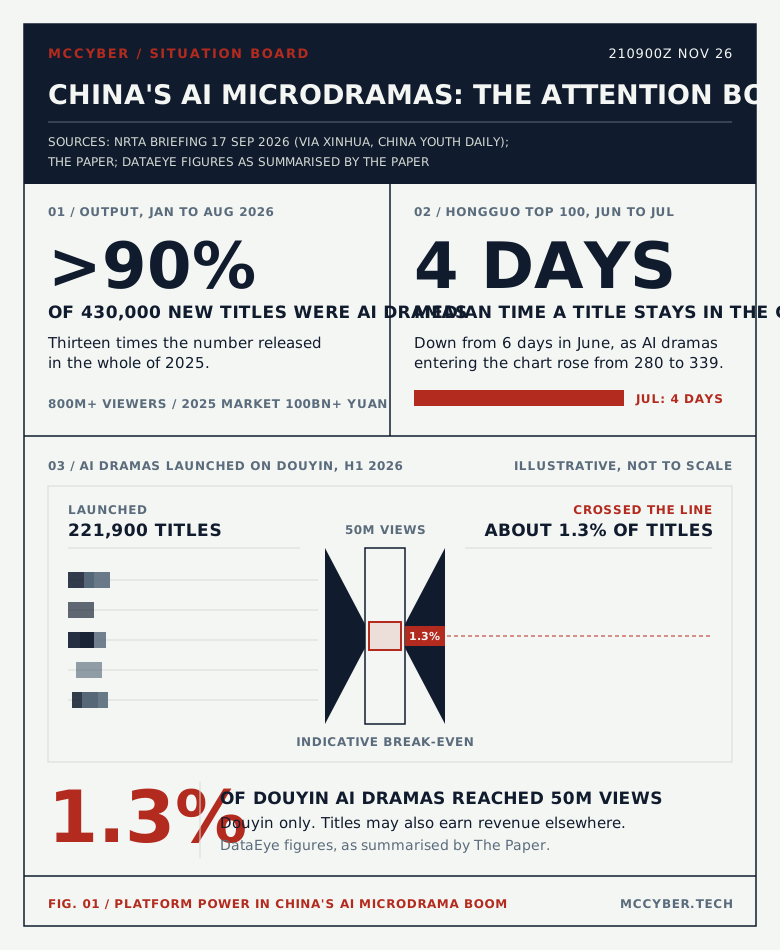
More than 90% of the 430,000 microdramas released in China in the first eight months of 2026 were AI dramas, according to China’s broadcasting regulator. The figure counts titles, not viewing, revenue or jobs. What the wider evidence shows is the power of the platforms that decide what gets seen; what it suggests is that cheaper AI production is adding to that power.
Microdramas are soap operas cut into episodes of a minute or two and watched on phones. At a State Council Information Office briefing on 17 September, Wang Xiaoliang, who runs online audiovisual regulation at the National Radio and Television Administration (NRTA), said China has more than 800 million microdrama viewers, that the market passed 100 billion yuan in 2025, and that this year’s eight-month total was 13 times the number released in the whole of 2025.
The tools and the shop window increasingly sit in one corporate group. ByteDance released Seedance 2.0 on 12 February, a video model it said could greatly reduce production costs for film, advertising and games. ByteDance also owns Douyin, and Hongguo, the leading free microdrama app, describes itself in its App Store listing as a Douyin Group product. In July 2026, Hongguo ranked fourth by total usage time among the 50 apps tracked in a Nomura report drawing on QuestMobile data, as cited by the commentator Qin Shuo.
Output has surged, but attention has not spread with it. According to figures from the data firm DataEye, as summarised by The Paper, only about 1.3% of the 221,900 AI dramas launched on Douyin in the first half of 2026 crossed 50 million views, an indicative break-even threshold. The calculation covers Douyin alone, and titles may also earn revenue elsewhere; nor does a share of titles tell us how many producers profit. It does show that only a small minority of titles crossed DataEye’s indicative break-even viewing threshold.
The competition for visibility is getting harder. The Paper found that 280 AI dramas entered Hongguo’s top 100 in June and 339 in July, while the median time a title stayed on the chart fell from six days to four. More titles are chasing the same ranked feed, and each holds its place for less time.
If the same group supplies the tool and runs the feed, who sets the price of entry? The evidence points to the platforms, through rankings, guaranteed funding and revenue terms. It does not show that they are capturing more profit, which the available data cannot measure. It suggests that as production gets cheaper, distribution becomes the scarce resource, and distribution here is concentrated.
The Linying film base in Hangzhou’s Linping district shows how that dependence works. The district promoted it as part of its bid to become the local government that best understands microdramas, and in September 2025 its deputy director, Zhang Congcong, said that at its busiest 10 crews worked there at once, about 300 to 400 people.
By April 2026, Zhang told Zhejiang’s provincial news service, daily crew numbers were down by almost 30% on a year earlier, and the base was offering free meals, discounts and longer bookings at the same price. The report gives three causes, not one. Seedance 2.0 arrived at the same time as Hongguo braked on live-action dramas and cancelled the guaranteed funding that kept many smaller producers solvent. Beneath both lay a bubble: studios had been built cheaply across the country and offered near-identical living rooms and hospital wards. Zhang also said AI’s cost advantage is clearest for scenes that are hard to build, and that for ordinary settings live shooting is still more convenient.
The account implicates platform funding decisions alongside AI and an oversupply of similar studios. It does not separate their effects, but it shows that one platform’s change of terms was part of what emptied the sets.
Get McCyber by email
Get McCyber by email: a weekly newsletter of new essays and snapshots on technology and state power, or each piece as it is published.
The state shaped this market from the start. Wang said the outline for the 15th Five-Year Plan lists microdramas, for the first time, as a new cultural format to develop vigorously, and local governments such as Linping built the studios. From 1 September, the NRTA’s Measures on the Development and Management of Microdramas required AI-generated episodes to carry visible labels. At the September briefing Wang called live-action drama “the main force” of quality production, said the regulator would guide platforms to open live-action sections and put real money behind them, and listed piracy and consent for the use of people’s likeness and voice as priorities. He reported 68,000 non-compliant microdramas removed.
So Beijing is pushing platforms to fund live-action production while tightening rules on disclosure, rights and content. One reading is that the regulator wants the scale of AI output without its reputational costs; that is an interpretation, not a stated motive. What the measures examined here do not establish is any mechanism for the people who make dramas to negotiate the transition.
The strongest challenge to this essay is that cheaper tools let far more people make commercially viable work. A drama that once needed a studio, a crew and actors can now be made by a small team. DataEye’s first-half report estimates that industry workers and individual creators in AI and animated drama together exceeded 500,000 by mid-year. Zhang himself made a 110-minute AI drama with university students, and Linying is rebuilding itself to sell AI-assisted planning instead of floor space.
The wider door is real. But everyone who walks through it competes for the same ranked feed, under terms a platform can change within a season, as Hongguo’s funding change showed. Opportunity in this market seems to depend less on the cost of production than on contracts, revenue shares and visibility rules that creators do not set.
That is the question China’s microdrama boom now poses. Will the people making these dramas have written contracts, transparent revenue shares and some collective voice in the terms that platforms such as Hongguo offer, or will each negotiate alone with the feed? Liberal democracies, whose own creators are adopting the same tools, should watch the answer closely.
Sources: National Radio and Television Administration (briefing of 17 September 2026, as reported by Xinhua and China Youth Daily; Measures on the Development and Management of Microdramas, full text as published by Xinhua); ByteDance Seed; Apple App Store (Hongguo listing); QuestMobile data in a Nomura report (as cited by Qin Shuo); DataEye (1.3% figure as summarised by The Paper; 500,000 estimate from DataEye’s report page); The Paper; Hangzhou Municipal Government; Hangzhou News; Zhejiang Online (Chao News).
Get McCyber by email
Get McCyber by email: a weekly newsletter of new essays and snapshots on technology and state power, or each piece as it is published.