AI is turning electricity into ammunition
The American military's appetite for fuel is famous enough to travel as a statistic without its footnotes. The more consequential change…
As France carries out what its interior minister calls the country's largest peacetime evacuation, and Spain fights its biggest recorded fire, the AI buildout is being blamed for fires it did not start. There is a more serious question underneath, and it concerns the electricity grid rather than the water main.
Enable JavaScript and use a browser with spoken audio support to listen.
Read aloud by your browser. Voice and availability depend on your device.
Around 330,000 people have been moved out of their homes in France and Spain, according to figures compiled by the Associated Press on 28 July. French interior minister Laurent Nuñez has described the operation around Bordeaux as what may be his country’s largest peacetime evacuation. A fire in the hills of Ávila, west of Madrid, has become the largest on Spanish record at more than 500 square kilometres, and at least 13 people have died in Spanish fires this year.
The other big story of the summer is the artificial intelligence buildout. Electricity used by data centres worldwide grew by 17% in 2025, and demand from AI-focused facilities surged by 50% in that single year, according to the International Energy Agency. Two enormous stories running at once, both involving heat and water, which is ample raw material for the internet to name a culprit. During the January 2025 Los Angeles fires, Californian lawmakers used the crisis to press for tighter controls and disclosure on data centre water use, introducing bills within days.
The water argument is the weakest of the available claims, and there is a better question underneath it.
Europe’s 2025 fire season was the worst since satellite records began in 2006. The EU’s Joint Research Centre mapped 7,783 fires burning 1,079,538 hectares across 25 member states, nearly double the 2006–2024 average. A three-week heatwave in August accounted for 460,585 hectares in Portugal and Spain alone. Germany, Spain, Cyprus and Slovakia all set national records.
The United States went the other way. The National Interagency Fire Center counted 77,850 wildfires in 2025, well above the ten-year average of 62,435. Those fires burnt 5,131,474 acres, over two million acres below both the five- and ten-year averages. In the year data centre demand grew fastest, American burnt area fell. Any argument in this area has to survive that.
Ignition is usually human, even where weather decides what happens next. More than 85% of US wildfires have a human cause, according to three decades of federal records. In Spain, human causes accounted for 97.6% of fires and 94.2% of burnt area between 2000 and 2016, on the national fire database.
Data centres use water twice over. They evaporate it to cool their servers, and they use it indirectly through electricity generation, particularly at thermal power stations that need water for steam and cooling.
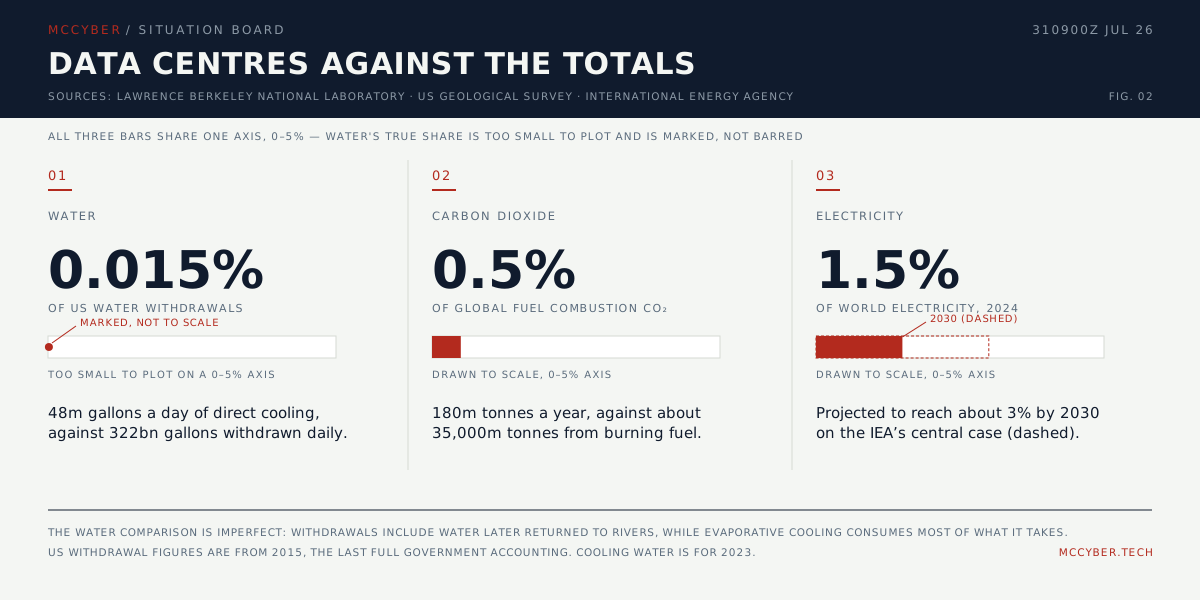
Lawrence Berkeley National Laboratory put American direct cooling use at 17.4 billion gallons in 2023, with projections of 38 to 73 billion gallons by 2028. That works out at about 48 million gallons a day, against total US withdrawals of roughly 322 billion gallons a day in the last full government accounting. The comparison is imperfect: those national figures are from 2015, and withdrawals include water later returned to rivers, while evaporative cooling consumes most of what it takes. Even so, the national share is small.
Where it matters is locally. Two-thirds of US data centres built or planned since 2022 sit in places already short of water, with five states accounting for 72% of them, according to Bloomberg’s analysis of World Resources Institute data. In Spain, Amazon’s three proposed sites in Aragón are licensed for about 755,720 cubic metres a year, roughly enough to irrigate 233 hectares of maize, and the company has asked to raise consumption at its three existing sites there by 48%, as SourceMaterial and the Guardian reported.
That is a real argument about who gets scarce water. It is not evidence that data centres start or worsen fires. Hydrants in Pacific Palisades failed on 7 January 2025 because three storage tanks holding a million gallons each, which supply the water pressure for hillside streets, emptied faster than the main pipe could refill them under four times normal demand for fifteen hours, according to the utility. That was a failure of local storage and pressure, in a watershed with no large data centre cluster. It is worth adding that the international firefighters’ association has warned that some of the firefighter testimony about AI water use circulating online was generated by AI and cannot be verified.
The second claim runs through the atmosphere. Data centres used about 1.5% of the world’s electricity in 2024 and produced roughly 180 million tonnes of carbon dioxide, against global emissions from burning fuel of about 35,000 million tonnes. Even on the IEA’s central projection, their operational emissions peak near 320 million tonnes by 2030 and stay below 1% of the annual global total.
Warming does drive fire. Human-caused climate change dried out western US forests enough to double the cumulative area burnt since 1984, adding some 16,000 square miles, in the standard study on the question. The fire weather behind the 2025 Iberian fires has become far more likely for the same reason. Data centres add to those conditions, in a small and recent share against a century and a half of burning coal, oil and gas. Pinning a particular fire on AI through this route is overreaching.
Subscribe
New essays and snapshots, by email, roughly weekly.
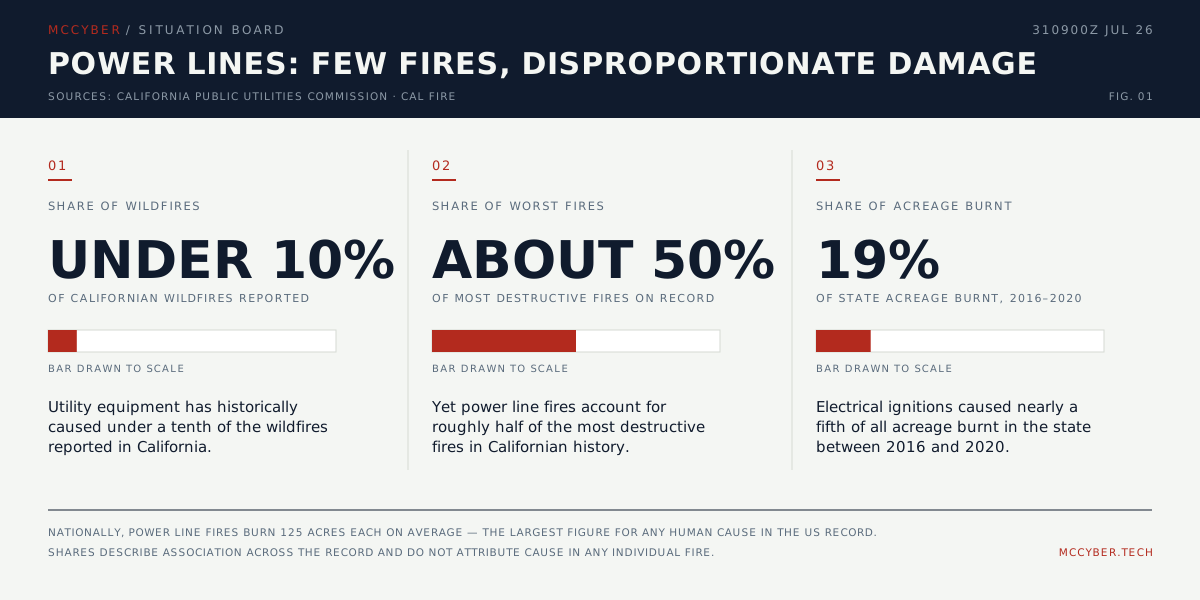
Much less has been written so far on the role of power lines, yet whilst they cause few fires, they are responsible for a startling share of the damage. Fires started by power lines burn 125 acres each on average, the largest figure for any human cause in the American record, according to Headwaters Economics’ analysis of federal fire data. The same analysis shows steep state-level rises, with Texas going from 67 power line ignitions in 1992–2001 to 4,474 in 2015–2024, and North Carolina from 32 to 2,903. Increases on that scale usually involve changes in how fires are recorded and classified as well as changes on the ground, and the published analysis does not separate the two.
California’s regulator gives the clearest picture of the imbalance. Utility equipment has historically caused under 10% of the state’s reported wildfires, yet power line fires account for roughly half of the most destructive fires in Californian history. Between 2016 and 2020, electrical ignitions caused 19% of all acreage burnt in the state.
The physical mechanism is well understood. As a wire carries more current it heats and expands, increasing how far it sags between poles. Wind then swings sagging wires into branches or into each other. Poles rot, split and fall, bringing live wires down onto dry ground. Any of those contacts can throw sparks.
The Eaton fire, which killed 19 people in Altadena in January 2025, shows how strange the failures can be. Edison recorded two electrical faults three seconds apart on a line five miles away at 6:11pm on 7 January, and a Pasadena security camera caught two flashes at the same moment, at a tower carrying a line switched off since 1971. The utility’s chief executive has said the leading theory is electromagnetic induction, the broad principle behind wireless charging, briefly re-energising the dead line. Edison continues to contest liability, and a court will decide on 11 August whether insurers can win compensation without a full trial.
This is where AI enters, and where care is needed. The US Department of Energy’s draft 2026 transmission study identifies rapidly growing loads, data centres prominent among them, as an increasingly important source of new transmission need, alongside the older problems of reliability, congestion and connecting new generation. The building is not keeping up. America needs roughly 5,000 miles of new high-voltage line a year and completed 888 miles in 2024, according to Grid Strategies.
It is tempting to complete the chain from there: more demand, hotter wires, more sparks. That step is weaker than it looks. Utilities do not run circuits without limits. Wires have thermal ratings, and protection systems, dispatch decisions and load shedding exist to keep them inside those ratings. Heavier demand on an ageing network plausibly means more circuits worked harder and more often, with more equipment to inspect and maintain, some of it in fire-prone terrain. Whether that raises the chance of an ignition is a separate question, and nobody has published an answer to it.
Three propositions need holding apart. Electrical equipment can start exceptionally destructive fires: established. Data centres are driving concentrated load growth and a scramble for new transmission: established. That this growth has raised the probability or severity of any wildfire: not established, and not currently measured by anyone. The roughly 180 million wooden poles in American service indicate the scale of the ageing network, and say nothing about how many sit on stressed circuits in dry country. The clearest published warning here comes from a company selling protective wrapping for poles, which makes it a prompt for enquiry rather than a finding.
The strongest objection is geography. Northern Virginia held 4,039.6 megawatts of data centre capacity at the end of 2025, about 43% of the 9,432 megawatts across America’s eight primary markets and nearly three and a half times the secondary markets combined, according to CBRE. Loudoun County faces nothing like California’s wildfire exposure, and neither do Ireland, Ohio or the Dallas corridor. Europe’s 2025 catastrophe fell on Galicia, Castilla y León and the Portuguese interior, none of them data centre markets, and this month’s French emergency is centred on the Gironde, where the binding factor is record-low moisture in the soil. AI also works the other way: western US utilities now use machine learning to decide which trees to cut back first and when to switch lines off ahead of high winds. Claiming a causal link the map does not support would damage the credibility of the well-founded concerns about water and grid stress.
There is still no evidence that demand from a data centre has caused a wildfire. What is documented is that very large new loads are being connected far faster than transmission lines get built or old equipment gets replaced, and that some of that equipment has already started fires which killed people. Where an electrical fault can become a lethal fire, planners and regulators should have to show that the network can carry new loads safely before a connection is approved, and utilities should be required to report whether large new customers change how hard circuits in high fire-risk areas are worked. Water deserves the same treatment during drought. The sensible question is whether governments are assessing these risks before approving the next wave of construction, rather than whether AI started this summer’s fires.
Sources: European Commission Joint Research Centre (EFFIS); Copernicus Climate Change Service; National Interagency Fire Center; US Geological Survey; US Department of Energy Office of Electricity; Lawrence Berkeley National Laboratory; International Energy Agency; California Public Utilities Commission; CBRE; Proceedings of the National Academy of Sciences; World Weather Attribution; Bloomberg; SourceMaterial; Associated Press; CNN; LAist; Inside Climate News; Claims Journal; Quartz; CTIF; Headwaters Economics; MOST Policy Initiative; T&D World.
The datasets behind this piece — wildfire records, utility ignition data, water and grid figures — are listed on the McCyber data page.
Subscribe
McCyber intelligence briefings and structural essays, directly. No institutional spin.