CRINK and the Shahed: what Russia's drone factory shows
Russia's Shahed factory at Alabuga runs on an Iranian design, Chinese-made assemblies and North Korean labour. That is serious, knowing…
Downloadable AI hacking tools are making autonomous intrusion campaigns cheaper and faster, and some have already succeeded. The public statistics that might show their wider impact are incomplete, and most describe the months before these tools spread. What can the figures tell us, and what would show that the danger is growing?
Enable JavaScript and use a browser with spoken audio support to listen.
Read aloud by your browser. Voice and availability depend on your device.
In mid-November two stories about American cybersecurity ran side by side. On the 13th the FBI issued a public alert about ARTEX, an open-source hacking framework driven by AI agents, which it said criminals and other malicious actors had used since at least August. In the days around the alert, failures hit airlines, banks and the National Security Agency’s internal network. On 18 November the Director of National Intelligence, Jay Clayton, told Congress the outages came from maintenance and upgrades rather than attack, while “the rate of patching, the rate of upgrading of systems is increasing”.
The Cloud Security Alliance now calls ARTEX and its imitators the third wave of AI-driven attack. A Sky News investigation went looking for the matching surge in long-running incident datasets and came back with a more surprising story. Both can be right. They measure different things, and mostly different months.
ARTEX appeared on GitHub in July, published for authorised security testing. An operator states a target and a goal in plain language; specialised agents turn that into commands, run standard attack tools and try another route when one fails. It works with any AI model; the FBI says attackers mostly choose cheap Chinese ones. On 23 November the Shadowserver Foundation counted about 4,200 exposed instances of such frameworks, roughly 70 per cent of them ARTEX.
Check Point Research, which read the databases of ten exposed consoles, estimates that whole criminal campaigns cost between about $145 and $1,500 in model fees. Rich Mogull, one of the CSA paper’s lead authors, drew the consequence: “A path that was never worth a human attacker’s time is worth an agent’s time.” Organisations once too small to bother with are now within reach for a few hundred dollars.
Check Point’s data shows how much of that effort is wasted, and how much still lands. One campaign harvested more than 300 app-signing certificates; three passed the operator’s checks, enough to sign arbitrary iPhone apps or to sell. A second hunted for cryptocurrency and moved no money, yet still dumped databases and exposed personal information. A third recovered more than 190,000 gaming logins; Check Point reports sampled validation suggesting about 3.3 per cent remained usable, potentially around 6,000 accounts. With no human-run baseline, these figures cannot show whether agents beat people. They do show why cheapness matters: when attempts cost almost nothing, a low success rate can still mean more victims.
State campaigns are similar. Microsoft reports that a China-aligned group using ARTEX sprayed passwords at 327 accounts in eight organisations, peaking at 2,900 failed sign-ins a minute without a single success. In a separate strand, after unauthorised access linked to ConnectWise’s cloud backup service, it attempted sign-ins to more than 2,250 cloud tenants and went on to act inside multiple customer environments. Across its ARTEX-driven attacks, Microsoft says, several reached privileged access, some in under three hours, though most of the targeting failed. The FBI alert cites no CVEs, only weak credentials, misconfigurations and other familiar weaknesses, and the UK’s National Cyber Security Centre found that none of the AI use it had observed “enabled a novel class of attack”.
What is new is speed, breadth and persistence. How far that has changed outcomes is harder to say.
Get McCyber by email
Get McCyber by email: a weekly newsletter of new essays and snapshots on technology and state power, or each piece as it is published.
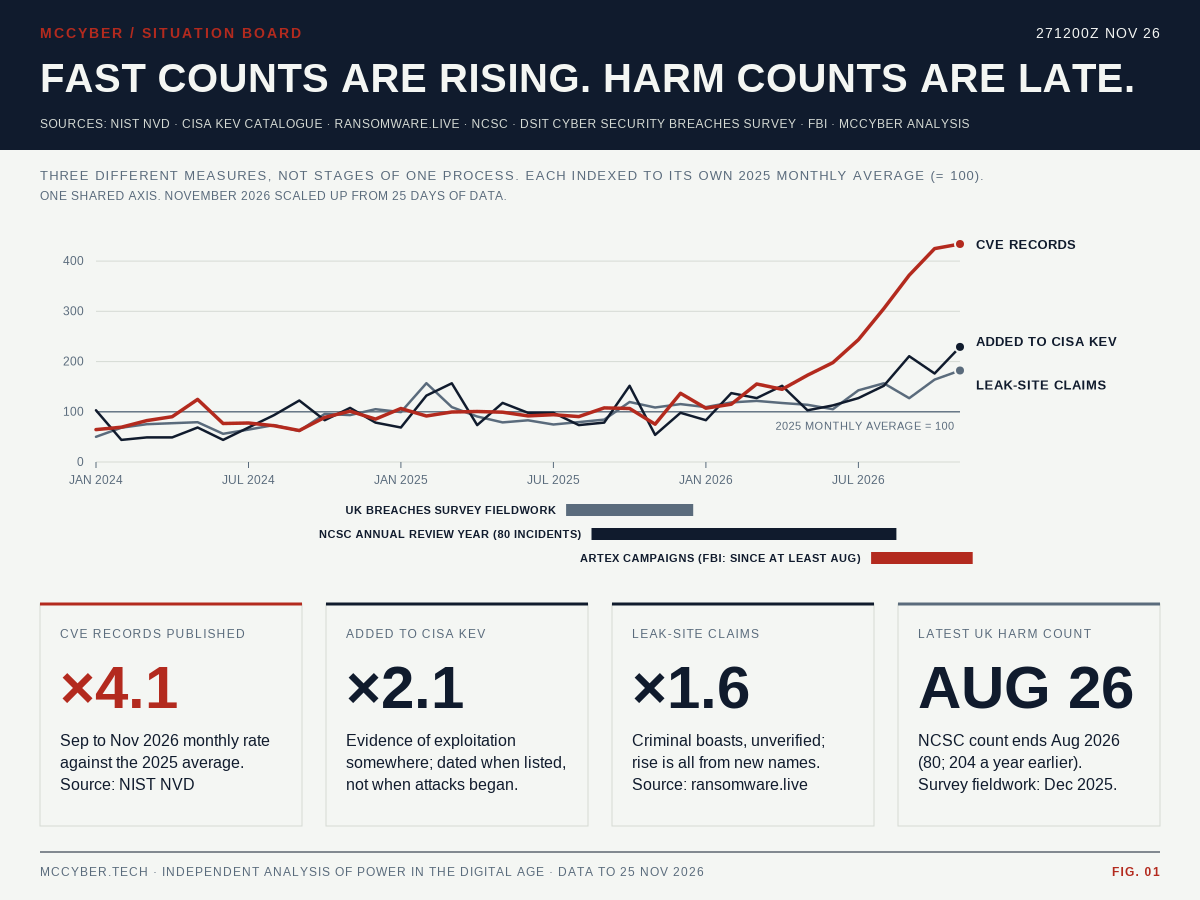
The official statistics mostly describe the wrong months. The government’s breaches survey found 43 per cent of businesses identifying a breach or attack, including attempts that never got past their defences, unchanged on the year before; a narrower measure, businesses suffering a negative outcome, was 19 per cent, against 16 per cent. Its fieldwork finished in December 2025. The NCSC classed 80 incidents as nationally significant in the year to August 2026, down from 204, but August is the earliest month the FBI gives for ARTEX campaigns, and the centre warns that its counts follow no simple trend. The 2026 review does not restate how it classifies incidents, so the comparison with earlier years needs care.
Faster series exist, but none measures harm directly. On McCyber’s count (method below), the National Vulnerability Database published 104,354 new CVE records between January and 25 November, more than twice the 2025 total; from September the monthly rate was 4.1 times the 2025 average. Additions to CISA’s catalogue of known exploited vulnerabilities ran at 2.1 times the 2025 rate. Each entry means CISA has evidence of exploitation, against ten organisations or ten thousand, and is dated when catalogued rather than when attacks began. Just over half the entries added since July were catalogued within a week of the flaw’s disclosure, against 37 per cent over the previous year. Credential abuse of the kind ARTEX favours appears in neither series.
Ransomware leak sites, where gangs name victims who have not paid, show claims at 1.6 times the 2025 rate. These are boasts rather than verified incidents, and every extra claim comes from a name absent in 2025: new gangs, rebrands or newly tracked sites. New gangs can still do real damage. Coveware, which covers only cases it handles, finds payment rates near historic lows but a rising median ransom and a pivot to pure data extortion; victims who refuse to pay can still lose heavily.
The result is a gap rather than a reassurance. Successful compromises are documented; how much extra damage autonomous hacking is causing, the public figures cannot yet say.
The NCSC warned in May that AI in skilled hands was exposing years of technical debt, and told organisations to prepare for a patch wave. The jump in disclosures is partly that wave, though the CVE Program’s own participants agreed in July that more data was needed to say how much. Clayton’s account of November’s outages points to an emerging cost, defence at speed taking services down, although nothing published shows that ARTEX prompted those particular patches.
Defence also works. In the CSA’s account, defenders using AI agents to sort alerts kept pace while others were overwhelmed, and one responder halted an attack for about 18 hours by telling the attacker’s AI that its activity was unauthorised. Endpoint protection blocked some moves in intrusions Google and the FBI describe.
That protection is probably uneven: agent-driven triage comes most easily to large, well-run organisations, while the newly viable targets are the ones without it. No public dataset yet shows how outcomes from autonomous attacks vary with the victim’s size.
The case for alarm starts from that timing gap. Incident reporting trails intrusions by months, and quiet intrusions may never surface. Microsoft says the same China-aligned group “achieved privileged cloud persistence at many organizations in a brief time”. Google expected multi-agent frameworks running whole intrusions within three months of its October report, and stealthier autonomous attacks within six. The CSA has yet to see a slow, patient campaign run by these frameworks, though one that worked would be hard to see. The NCSC’s chief executive warned this month of “a real prospect of an unprecedented rise in the number of cyber incidents”.
The evidence supports a narrower claim than either the alarm or the reassurance: successful autonomous intrusions are documented, while their additional harm across the wider economy remains uncertain. Evidence of worsening harm would include more organisations reporting serious incidents, greater severity, rising recovery costs and more service disruption traced to attacks, none of them required on its own. The next surveys and incident counts will cover the period in which these tools spread, and they may reveal worsening harm. They will not, by themselves, show how much of it autonomous hacking caused, since conventional attacks, changes in reporting and better defence all move the same totals. Establishing that will require evidence from the incidents themselves.
How we counted (data collected 26 November 2026): CVE records are those the NVD published, by its publication date, excluding rejected records. Catalogue figures use the date CISA added each entry. Leak-site claims come from ransomware.live, dated by its attack-date field, which is often the day a post was found; they are not de-duplicated, and about 6 per cent of 2025 and 2026 posts share a victim name with another post. "The 2025 rate" is the 2025 monthly average; the latest rate is the September to November 2026 average, with November projected from 25 days of data. The monthly counts and a fuller method note are published.
Sources: FBI; Cloud Security Alliance; Sky News; Shadowserver Foundation; Check Point Research; Microsoft Threat Intelligence; Google Threat Intelligence Group and Mandiant; National Cyber Security Centre; NIST National Vulnerability Database; CISA; ransomware.live; Department for Science, Innovation and Technology; Coveware by Veeam; CVE Program; Nextgov/FCW.
Get McCyber by email
Get McCyber by email: a weekly newsletter of new essays and snapshots on technology and state power, or each piece as it is published.
Is something here unclear, or is there a question this piece left open? Ask, and it goes to the editor.
Every request is read. A reply is not always possible. An email address is used only to answer you. You can also send this by email.