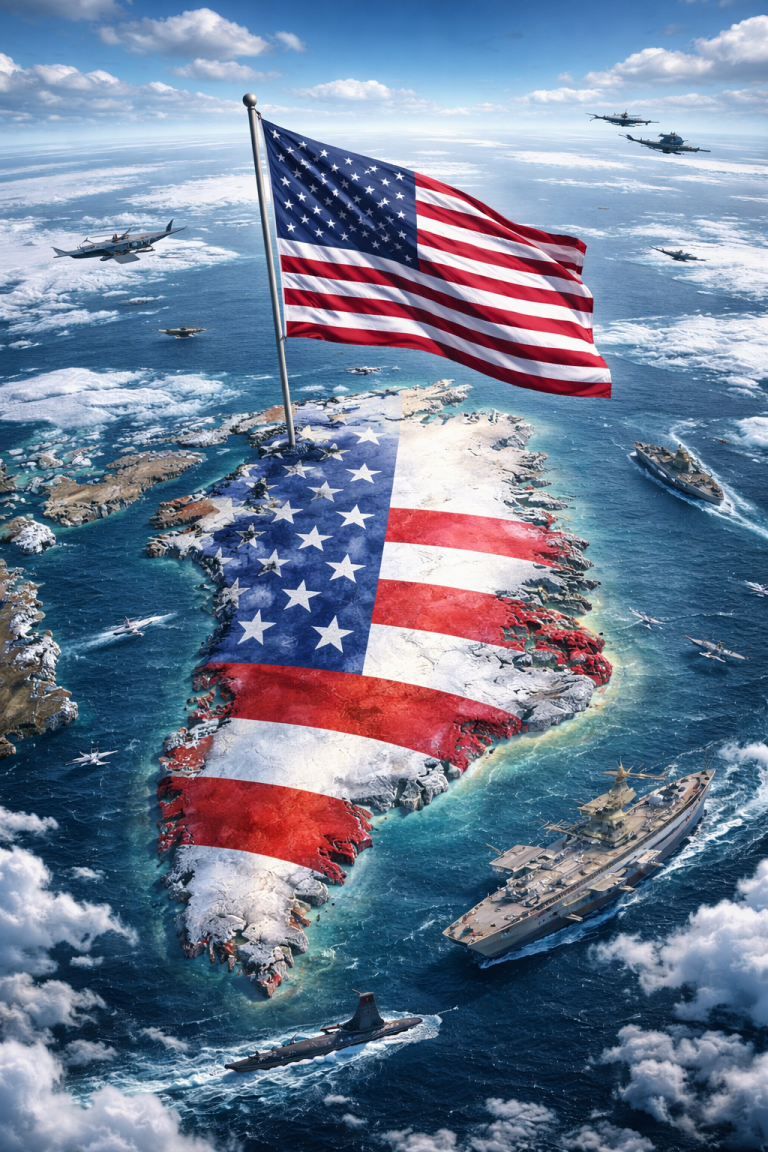
In recent years, U.S. President Donald Trump and his “Make America Great Again” (MAGA) supporters have renewed calls for the United States to acquire Greenland from Denmark. To many observers, especially in Europe, this idea seems startling—even imperialistic. Yet within Trump’s circle and base, a variety of reasons are put forward to justify taking control of the world’s largest island. These justifications fall into two broad categories: factual or strategic rationales on one hand, and rhetorical or ideological appeals on the other. Below is an objective explanation of the arguments they use—from concrete military and economic calculations to emotive nationalist slogans—presented without endorsement or critique. We distinguish which arguments are strategic facts and which are rhetorical or ideological in nature, all contributing to a unified MAGA case for “American Greenland.”
Strategic Rationales for Acquiring Greenland
1. Geostrategic and Security Importance:
A core justification is Greenland’s unparalleled strategic location in the Arctic. American military planners note that the shortest route for Russian intercontinental ballistic missiles to reach U.S. cities is over the North Pole—directly above Greenland. Whoever controls Greenland, they argue, controls the early-warning radar systems that could spell the difference between American survival and annihilation in a nuclear conflict. During the Cold War, the U.S. and NATO understood that the GIUK Gap—the narrow water passage between Greenland, Iceland, and the United Kingdom—is a chokepoint for Russian submarines. Controlling Greenland helps ensure hostile subs cannot slip into the Atlantic to threaten America’s east coast. Today, Russian submarines still patrol those frigid waters, and Trump’s supporters contend that a U.S.-controlled Greenland would fortify this critical defensive line. In addition, climate change is rapidly melting Arctic ice, opening new sea lanes and opportunities for adversaries. MAGA strategists warn that the nation which controls Greenland “will determine who dominates the Arctic century,” as Russian and Chinese ships and even military bases encroach further north. Trump himself has stated that America “needs” Greenland for national security, even tying it to a missile defence initiative dubbed the “Golden Dome” or “Golden Shield” project. In a recent social media post, Trump wrote that Greenland is “vital for the Golden Dome that we are building”—a reference to an expanded missile defence shield—and argued that NATO should help the U.S. obtain the island. In short, the strategic argument holds that American control of Greenland would provide an Arctic “shield” guarding the homeland and NATO’s northern flank. Any risk or cost is, in this view, outweighed by the imperative to “deter our adversaries in the Arctic region.”
2. Military Presence and Early Warning Systems:
Greenland already hosts Thule Air Base (Pituffik Space Base), a U.S. installation crucial for missile warning, space surveillance, and arctic air defence. However, under Danish sovereignty, U.S. rights there rely on agreements rather than ownership. Trump supporters claim this arrangement is inadequate and leaves America vulnerable. They point out that since 1951 the U.S. has maintained bases in Greenland by treaty, but ultimate control remains with Denmark—a “strategic vulnerability.” Acquiring Greenland outright would allow the U.S. to expand runways, ports, and radar installations freely. This is portrayed as crucial for keeping an eye on Russian bomber patrols and any Chinese ambitions in the Arctic. Indeed, Beijing has declared itself a “near-Arctic state” and tried to buy stakes in Greenlandic airports and mines. MAGA proponents cite examples like a Chinese company’s attempted purchase of a former Greenland naval base and Chinese mining interests on the island as proof that China seeks a foothold if America doesn’t act first. Trump has warned in dire terms that “if we don’t [secure Greenland], Russia or China will,” suggesting that allowing a rival power to dominate Greenland would fatally undermine Western security. From this standpoint, taking Greenland is a defensive move to preempt adversaries, not an act of aggression.
3. Natural Resources and Economic Opportunity:
Beyond military considerations, Greenland’s vast mineral wealth is a major factual rationale. The island is often described as a treasure trove of rare earth elements and other critical minerals buried in its ancient rocks. By some estimates, Greenland’s untapped mineral resources could be worth trillions of dollars. These include rare earth metals needed for smartphones, electric vehicle batteries, wind turbines, guided missiles, and other high-tech applications. At present, China controls nearly 80% of global rare earth production, a dominance it has leveraged against U.S. interests in trade disputes. MAGA strategists argue that securing Greenland’s rare earth deposits would “break China’s stranglehold on critical resources” and restore American supply independence. In addition, Greenland’s coastlines may contain significant oil and gas reserves. While much of these resources are currently uneconomical to extract, climate trends and technology could change that, and supporters say American investment could unlock these riches. The economic argument holds that an American Greenland would pay for itself: one analysis by a U.S. think tank valued Greenland’s strategic location and its confirmed mineral reserves at several trillion dollars, far exceeding any price the U.S. might pay Denmark. In Trump’s transactional view, this would be “the deal of the century.” MAGA voices also note that Greenland’s huge landmass is geographically part of North America and bigger than the Louisiana Purchase and Alaska Purchase combined—acquisitions once called foolish but later proven extremely valuable. By drawing this historical parallel, they suggest Greenland is a rare chance to secure a strategic asset that future generations of Americans will thank them for.
4. Historic American Interest and Precedent:
Supporters emphasise that the idea of U.S. control over Greenland is not new or uniquely “Trumpian,” but part of a long bipartisan tradition. They recount how Secretary of State William H. Seward (who purchased Alaska in 1867) had identified Greenland as vital the very same year, even commissioning a survey of the island’s harbours and resources. Congress refused to fund Seward’s plan, a missed opportunity MAGA historians say America has “been trying to recover ever since.” They note the World War II experience as proof of Greenland’s importance: when Nazi Germany occupied Denmark in 1940, the U.S. moved swiftly (with Danish assent under duress) to establish bases in Greenland to prevent a German foothold. President Franklin D. Roosevelt’s 1941 Defence of Greenland Agreement gave the U.S. broad rights on the island—a bold act that “established the strategic footprint that protects the homeland to this day.” After WWII, President Harry Truman outright offered $100 million in gold to buy Greenland in 1946, recognising that the emerging Soviet threat made permanent U.S. control highly desirable. Denmark refused, preferring to keep its colony, but had to grant base access in the 1951 treaty. MAGA advocates describe this outcome as a half-measure that left a “strategic ambiguity” unresolved for 75 years. According to this narrative, every U.S. president since understood Greenland’s importance but only Trump had “the courage to say out loud” that America must finally secure it. Trump’s cancellation of a 2019 state visit to Denmark after its Prime Minister mocked his purchase idea is cited as evidence of his resolve to put American security first. Thus, MAGA proponents frame the Greenland move as finishing the work of visionary leaders like Seward, Roosevelt, and Truman—a rightful course correction of history. In their view, 2026 is simply the moment America finally acts on a “160-year consensus” that Greenland is essential to U.S. security.
5. Greenlanders’ Self-Determination and Welfare:
Interestingly, one prong of the pro-acquisition argument focuses on the people of Greenland (mostly Inuit Kalaallit) and their future. While on the surface the notion of a U.S. takeover sounds like old-fashioned imperialism, Trump-aligned commentators insist their goal is to liberate Greenland’s population from European colonialism and provide them greater rights and prosperity. They point to Greenland’s colonial history under Denmark: for two centuries Denmark treated Greenland as a dependency, and even after granting home rule, Copenhagen retains control of defence, foreign policy, and monetary policy. MAGA narratives highlight historical injustices—such as Danish authorities’ coercive sterilisation of Inuit women in the 1960s–70s and other abuses—as evidence that Greenlanders have been mistreated under Danish rule. They note that opinion polls show a majority of Greenland’s people favour eventual independence from Denmark. All major Greenlandic political parties seek more autonomy or independence, but the island’s tiny population and economic dependence on an annual Danish subsidy have made full independence difficult. Here is where Trump’s camp offers an appealing vision: Greenland could join the United States (whether as a state or territory) and receive American investment, infrastructure, and an upgrade in living standards, while finally shedding colonial ties. Greenlanders would ostensibly gain U.S. citizenship with full rights and protections—“anything less would simply repeat the injustices of history under a different flag,” as one open letter from a Trump supporter put it. Advocates claim this would be a win-win: Greenlanders get self-determination and prosperity, America gets a loyal strategic partner. They even characterise a future union as an anti-colonial outcome: “a rare example of anti-colonial integration,” in which a once-colonised people freely choose to join the American republic. This argument stresses that the U.S. would treat Greenland not as a conquered colony but as an equal member (even suggesting eventual statehood), with respect for Indigenous rights and environmental safeguards. In essence, MAGA supporters portray the U.S. as a more benevolent guardian for Greenland than Denmark: a partner who will invest in Greenland’s future (from mining to education) and defend it, while honouring the will of the Greenlandic people if they vote to join America. Trump has repeatedly said he supports Greenland’s right to decide its own fate, implying that if the Greenlanders chose America, Denmark should not stand in the way. To sceptics, this might sound like a convenient moral veil for a strategic land-grab. But within the pro-Trump discourse, Greenland’s freedom is sincerely offered as one justification for the U.S. acquisition—casting America not as an invader, but as a liberator fulfilling the wishes of an oppressed people.
Rhetorical and Ideological Appeals
Alongside the concrete strategic points above, Trump and his MAGA base employ a range of rhetorical, symbolic, and ideological arguments to rally support for acquiring Greenland. These are less about hard security facts and more about nationalist sentiment, American destiny, and even internet meme culture. Importantly, such appeals serve to frame the Greenland issue in populist, emotionally resonant terms that energise Trump’s core supporters.
“America First” and Nationalist Ideology:
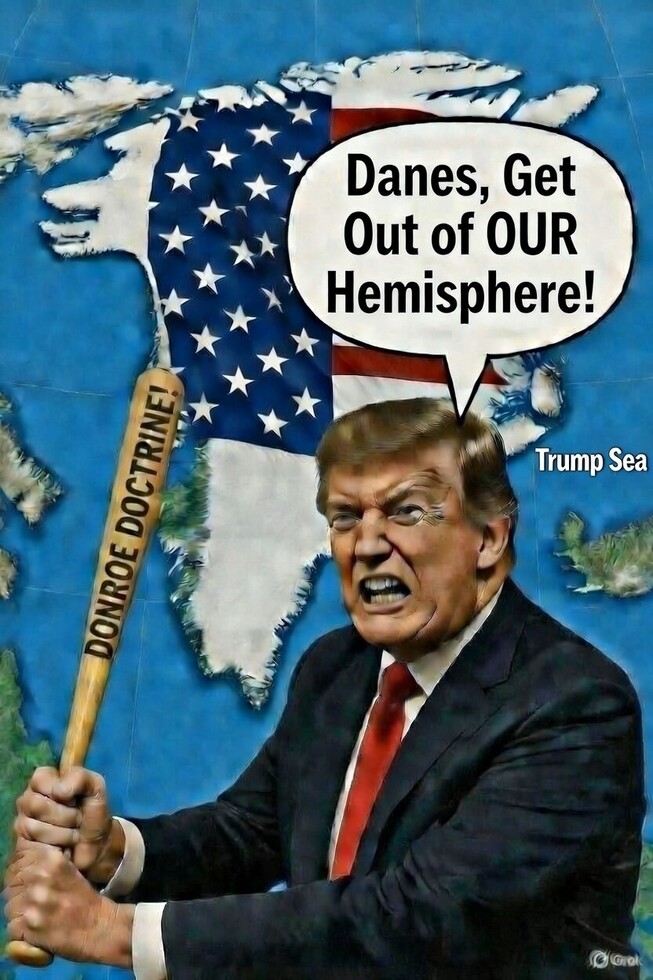
The MAGA movement (so named for Trump’s slogan “Make America Great Again”) approaches foreign policy with an unapologetic America First mentality. Core Trump voters tend to believe in American exceptionalism and are often distrustful of multinational alliances or liberal European elites. In their view, the U.S. has every right to assert its interests unilaterally, especially in its own hemisphere. The idea of purchasing or taking Greenland plays into a sense of manifest destiny and U.S. primacy. Some invoke the Monroe Doctrine—traditionally a policy opposing European colonialism in the Americas—to argue that a European power (Denmark) should not hold territory in North America. On social media, Trump fans half-jokingly refer to this as the “Donroe Doctrine,” after Donald Trump. The message is that Greenland belongs in the U.S. sphere of influence and that “Danes get out of our hemisphere.” This ideological stance is cast as a continuation of America’s 19th–20th century expansion, now updated for the 21st century Arctic. For MAGA adherents, it’s even a point of pride to envision the map with Greenland coloured red-white-and-blue.
Memes, Slogans, and Provocative Humour:
The campaign to get Greenland has also been propelled by MAGA-aligned meme culture. On platforms like Truth Social (Trump’s social network), enthusiasts share over-the-top lists of reasons why “we should invade Greenland”—mixing serious points with tongue-in-cheek trolling. For example, one viral post gleefully exclaimed: “So many cool reasons to invade Greenland! Save defenseless Eskimos from brutal colonialism! Enforce the Donroe Doctrine! Stop China from stealing rare earths! Staging post for Canada and Russia invasions! End NATO & EU! Natural cooling for crypto mining and meme creation! Nuclear test site! ICE internment camps far from the lamestream media! Whale-hunting vacations at Trump Nuuk!” This satirical rant even joked that after victory, Nuuk (Greenland’s capital) should be renamed “Trump Kirk” in honour of a conservative activist, and that “the Atlantic Ocean = Trump Sea.” Clearly, much of this is facetious exaggeration. However, it reflects the tone in certain MAGA circles—a defiant, own-the-liberals bravado that turns a serious geopolitical move into a kind of nationalist spectacle. By bandying about outrageous ideas like building a “Trump Nuuk” luxury resort or using Greenland’s frigid interior as a detention site where liberal media scrutiny can’t reach, these memes galvanise Trump’s base and mock the sensibilities of critics. They transform Greenland from a dry policy topic into fodder for the culture war. The underlying message is that acquiring Greenland would be an epic triumph for Trump and his movement—“Do it for history!” as the meme says—and a thumb in the eye to the establishment. Trump himself has indulged in this showmanship, famously tweeting a photo of a golden Trump Tower photoshopped onto a Greenland village (captioned “I promise not to do this to Greenland”) in 2019, to signal both his interest and his trademark humour. Such rhetorical flourishes don’t carry strategic weight, but they help sell the idea to his followers in a fun, prideful way.
Anti-Europe and Anti-NATO Sentiment:
Many of the ideological justifications also tap into a strain of scepticism or resentment toward European allies and multilateral constraints. Trump’s base often views institutions like the EU and NATO as ineffectual or unfair to the U.S. In the context of Greenland, this translates to arguments that European objections—whether from Denmark or the EU at large—should not override American security needs. Some hard-line supporters even cheer the notion that taking Greenland could “end NATO & EU!”, as in the sarcastic Truth Social post. While that is hyperbole, the broader sentiment is that NATO exists to serve U.S. interests, not to bind America’s hands. Trump has asserted that NATO’s purpose is to protect members from external threats, “not to prevent America from securing strategic positions essential to its defence,” effectively rebuffing allies’ complaints about U.S. actions. In speeches and posts, he reminds audiences that the U.S. carries the majority of NATO’s military burden, and suggests that Europeans who “lecture” America on international law or Danish sovereignty are hypocritical given Europe’s reliance on U.S. protection. By this logic, Denmark’s inability to fully exploit or defend Greenland is seen as an argument for America stepping in, even if it ruffles NATO unity. The MAGA base, which often embraces unilateral action, resonates with Trump’s portrayal of alliances as secondary to American security. In their eyes, acquiring Greenland is a bold assertion of U.S. interests despite Euro-elite disapproval—very much in line with the America First ethos. This ideological framing turns what might be a diplomatic breach into a virtue: a sign of strength and independence from Europe’s opinion. It also connects with domestic politics—portraying Trump as fulfilling his promise to put America’s needs above globalist niceties.
Patriotic and Symbolic Motivations:
Finally, the justifications carry a strong undercurrent of patriotism and the desire to cement Trump’s legacy. Trump and his supporters present the Greenland acquisition as a grand patriotic endeavour that future generations would celebrate. They invoke past U.S. triumphs: just as Thomas Jefferson doubled the nation with the Louisiana Purchase and Seward’s “folly” of buying Alaska proved foresightful, Trump securing Greenland would be remembered as a masterstroke. The notion of adding the 51st state (or perhaps the 52nd, if Puerto Rico is counted) appeals to those who want to see American territory and power expand. There is even a financial populist twist: MAGA commentators have pointed out that Greenland’s entire population could be generously compensated—for example, at $100,000 per resident, totalling under $6 billion—which they note is a “rounding error” in the U.S. budget. Such figures are floated to suggest the human element is manageable and that the American government (or even private sector, as Trump the real-estate magnate mused) could “buy out” Danish interests and invest in the people. It is a businesslike framing that resonates with Trump’s image as a dealmaker: why not simply make a deal and win big for everyone? Even when discussing military options, Trump’s rhetoric often emphasises American greatness and resolve rather than details. He has signalled that “utilising the U.S. military is always an option” for Greenland, not to threaten war per se, but to project an image that the U.S. will do whatever it takes to protect its interests—just as Monroe Doctrine Presidents did in centuries past. When Trump declares that “American dominance in the Western Hemisphere will never be questioned again,” it appeals to his base’s nationalism and frames Greenland as the next chapter in asserting that dominance. In summary, these ideological and symbolic arguments rally supporters by casting the acquisition of Greenland as a bold, patriotic mission—a chance to make history, assert American exceptionalism, and prove the doubters (foreign and domestic) wrong.
Conclusion
Taken together, the strategic and rhetorical arguments form a unified rationale in the eyes of Trump and his followers. In their narrative, acquiring Greenland is simultaneously a prudent move to secure America’s future and a grand statement of American power and values. On one level, the case is built on hard realities: military bases and missile defence, rare earth minerals and Arctic shipping lanes, centuries-old strategic calculations and the self-determination of Greenlanders. These factual points are presented as compelling reasons why the U.S. must act in Greenland—before Russia or China do, and before Denmark’s hold stymies the island’s potential. On another level, the case is driven by ideological conviction and populist energy: the belief that America has a destiny to lead, that Trump is the leader bold enough to fulfil it, and that notions of diplomatic decorum or European consent should not hinder what is “right” for America. By explaining these justifications clearly—separating the genuine strategic interests from the passionate slogans—one can better understand why the idea of “American Greenland” has gained traction in MAGA circles. Trump and his supporters have woven these strands into a single storyline: that taking Greenland is not conquest or folly, but rather the logical and even noble course for a nation intent on putting itself first in a new era of great power competition.